

2026年2月10日
Why Japanese have lost job motivation

Japanese do not work hard?
As you know, long working hours are one of the most serious issues of Japan. Many of Japanese workers suffer from physical or mental health problem even today.
The Japanese government and companies have implemented various measures to solve these issues, such as reducing working hours, promoting paid leave usage, and preventing harassment.
However, this problem is now being resolved in a rather peculiar way. Surprisingly, the number of Japanese people has lost their enthusiasm for work. Though the Japanese are often said they are working too hard, what exactly happened to them?
An increase of “quiet quitting”
To be honest, more and more people in Japan’s workplaces today are giving up on promotions and raises, refusing to work overtime, and working only the bare minimum required. These workers are called “quiet quitting,” and they are found not only among young people but also among middle-aged workers.
Adecco Japan, the Japanese subsidiary of the Adecco Group which provides human resources services, defined the state of “having no enthusiasm or motivation for work but performing the bare minimum required tasks” as “quiet quitting” and asked to respondents whether you are on the state. The survey found that approximately 70% of labors aged 18 to 59 responded “Yes” or “close to Yes1.”
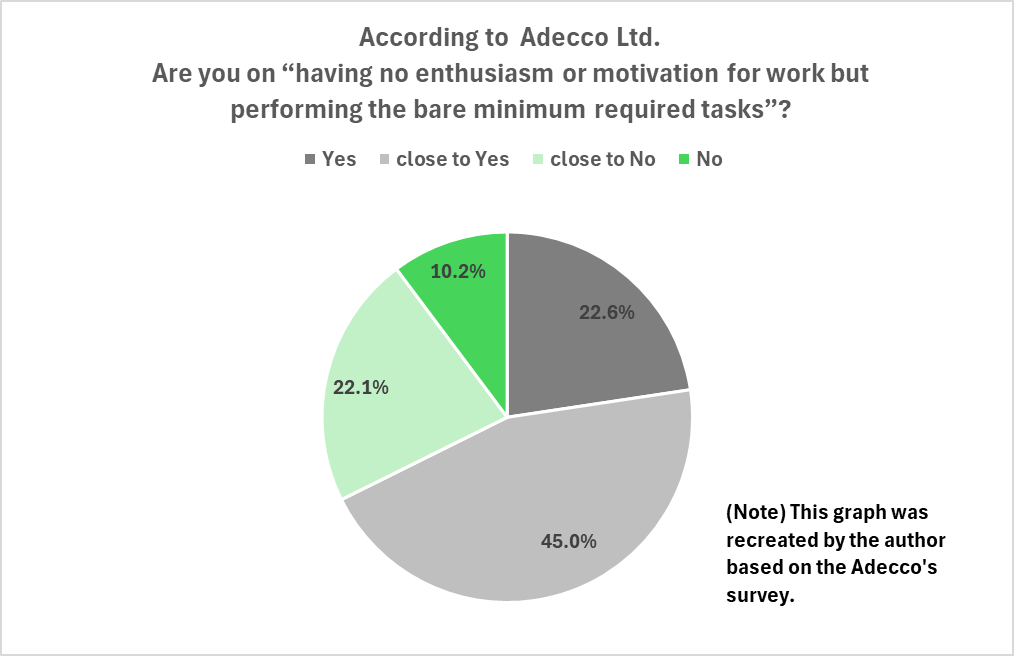
Another survey shows similar results. According to a survey by Mynavi Career Research Lab, 44.5% of full-time employees aged 20s to 50s reported “I’m doing quiet quitting2.” This percentage is lower than Adecco’s survey, but over 40% of respondents admitted themselves to practicing quiet quitting. These results indicate that many Japanese employees today lack enthusiasm for their work actually.
Why Japanese people stopped working hard
So why Japanese people stopped working hard? There are several possible reasons, but here I’m gonna introduce the three main reasons.
First, because of decline in ambition for promotion due to poor company treatment. In the past, Japanese salarymen have great motivation for work and aimed promotions and pay raises. However, since the collapse of bubble economy in the 1990s, Japan’s economy has been covered with deflation and made it difficult for companies to give enough salary. So, even if worker gets promoted, one gets more workloads and responsibilities without acceptable salary increase. Such cases are often seen in many Japanese companies now. Therefore, employees feel that “if it’s not worth the effort, it’s better not to try hard.”
The second reason is that more people now prioritize family and personal life. Since long working hours became a societal concern, a lot of people became to think that work isn’t everything in life. More people now make a point of time with family or personal time than work. This value shift has also influenced Japanese attitudes toward work.
Thirdly, that’s because it has become difficult to reprimand for unmotivated workers. In the past, if we refused overtime work or worked with less enthusiasm, we would have received reprimands from superiors. However, due to stricter compliance requirements and the need to prevent employee resignation, it has become increasingly difficult to pressure such employees. Consequently, we got easier environment to do “quiet quitting” than before. I guess that is also one of the main reasons why this work style was spread.
Why they don’t change job
By now, you may be thinking, “If you’re unhappy at work, why not just change jobs?” That’s exactly. However, in Japan, people tend to choose to stay with their company rather than change jobs. Because they fear that changing jobs may lead to worse conditions than the company belong to now.
According to PERSOL RESEARCH AND CONSULTING Co., Ltd, Japanese workers have low satisfaction at all five indicators: “company as a whole,” “workplace relationships,” “immediate supervisor,” “personal life,” and “job content.” However, they also have the lowest job-changing intentions among 14 countries and regions3. Many Japanese workers remain in their jobs despite workplace dissatisfaction because of anxiety about changing jobs.
It’s gonna be difficult to keep quiet quitting
I understand the feelings of those who choose quiet quitting. When I was working at first company, I had dissatisfaction with money incentive and saw my boss working longtime. At first, I felt despair at how steep the career path seemed.
But quiet quitting is certainly not a wise choice. When they have been doing “quiet quitting”, it is less possibility they are fired now. However, it is often said Japanese companies are getting difficult to maintain lifetime employment systems4. So, even if they can maintain this work style while young, there’s no guarantee they can sustain it into their 60s. While they might not be fired, there’s a real possibility they could be pressured into voluntary retirement. Therefore, I do not recommend quiet quitting.
Conclusion
This phenomenon may be surprising for foreign readers, but this is the reality in Japan. The structure workers can’t get financial rewards has taken away their motivation.
- アデコ株式会社「X・Y・Zの3世代・2,050人の就業者を対象にした、「静かな退職」と「理想の上司」に関する調査」2025/12/16 https://www.adeccogroup.jp/pressroom/2025/1216 ↩︎
- マイナビキャリアリサーチLab「正社員の静かな退職に関する調査2025年(2024年実績)」2025/4/22 https://career-research.mynavi.jp/reserch/20250422_95153/ ↩︎
- パーソル総合研究所「APAC就業実態・成長意識調査(2019)」2019/08/27 https://rc.persol-group.co.jp/thinktank/data/apac_2019/ ↩︎
- A unique Japanese employment practice whereby once hired as a regular employee, one has been hired until retirement age. While there is no legal basis, it is said it has become established during rapid economic growth alongside the seniority system. ↩︎