

2026年2月10日
Why have Japanese highly educated begun to enter startups?

Highly educated begin to enter startups?
Until recently, most of Japanese university students used to aim to enter a major company. Securing a position at a major company meant gaining economic stability and a guaranteed future. Therefore, graduating from a prestigious university and joining a major corporation was elite path in our country.
However, now we can see changing of Japan’s employment landscape. Surprisingly, some of top universities students choose to join venture companies. Venture companies often have relatively unstable management and lack company brand. So, Japanese tended to avoid entering Venture and it seems quite puzzling for Japanese adults that highly educated students deliberately choose these paths.
Such cases were literally rare before. I guess that this trend emerged from the 2020s. So, what is happening now in Japanese student’s job hunting?
Why Japanese Gen Z join startups
The reason more college graduates are joining startups is to get skills early on. Japanese workers have traditionally been protected by the lifetime employment system1. However, it is often said that it has become increasingly difficult to maintain the system in recent years. Therefore, Japanese workers now being required to acquire business skills so they can earn money without relying on their company.
Given this situation, some young people are increasingly turning their attention to startups. In large corporations, it often takes years to be entrusted with positions of responsibility, and regular employees in these companies have limited discretion.
In contrast, startups expect new hires to contribute as productive members immediately upon joining, allowing young people to work on the front lines from the start. By working in this way, they can gain extensive experience, develop skills, and build flexible careers.
Gen Z’s anxiety about career development
Japan’s Generation Z feels particularly anxious about career development. Openwork, a human resources service provider, surveyed Gen Z employees who resigned within three years about their reasons for quitting. The top reason was “Career/Personal Growth (31.7%)”, followed by “Job Satisfaction (20.2%)” and “Work Relationships/Company Culture (20.0%)2”.
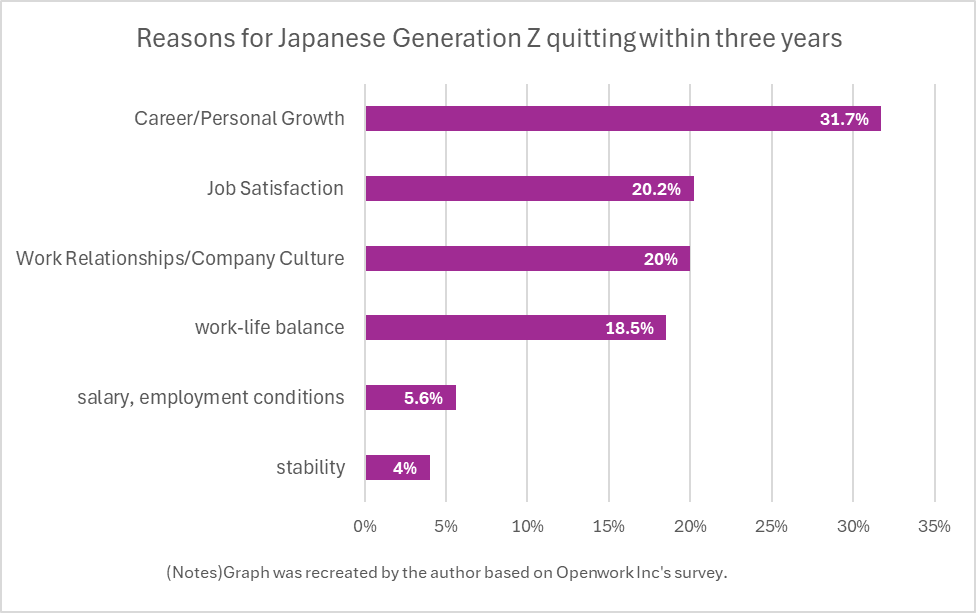
Concerns about career advancement was the primary reason for resignation. Thus, we see that career development and skill acquisition have become major concerns for today’s youth. The reason they feel such anxiety is that they have seen their parents’ generation facing early retirement offers. Seeing that, they got fear, thinking, “If I don’t get skills, I’m gonna end up the same way.”
Younger quit a job because their job was too easy
Recently, Japanese companies have been implementing various workplace improvements to prevent young employees from quitting. While compliance has tightened in Japan in recent years, leading to organizational reforms like reducing overtime hours and eliminating harassment, companies are also being mindful of young employees by avoiding practices like assigning too much work or reprimand severely to new hires.
However, it was backfire. Young employees felt career anxieties like “I’m not being given job and responsibilities” or “My workplace is too relaxed for me to grow,” and it leads them to think, “I’m not dissatisfied with my workplace, but I wanna go to a company where I can get skills more,” which ultimately leads to resignation. Thus, Japanese management now faces the delicate challenge of striking a balance: drawing clear lines against overwork and harassment while simultaneously providing an appropriate environment for growth.
- A unique Japanese employment practice whereby once hired as a regular employee, one has been hired until retirement age. While there is no legal basis, it is said it has become established during rapid economic growth alongside the seniority system. ↩︎
- オープンワーク株式会社「3年以内に辞めたZ世代の入社&退職理由ランキング(vol. 130」」2025/2/27 https://hatarakigai.openwork.jp/posts/56409598 ↩︎