

2026年2月10日
Why Japanese university students get depression


Serious younger’s depression
Work-related stress plague many Japanese workers, but Japanese university students also suffer from job-related stress.
According to 厚生労働省(the Ministry of Health, Labour and Welfare), the largest number of university students who committed suicide in 2024 were 21 years old, with “career path concerns” being the most common cause1. In Japan, many people engage in job hunting during their third year of university, meaning at age 21. This job-hunting process, called “shukatsu,” is the biggest hurdle for Japanese university students actually.
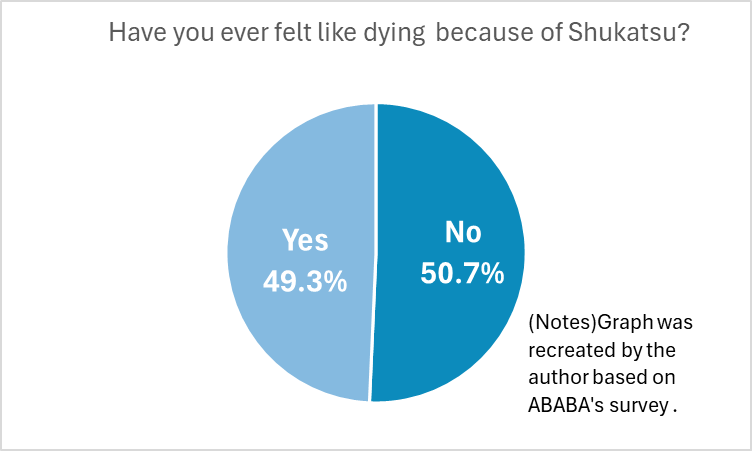
In the survey by ABABA, 49.3% of respondents answered “yes” to the question, “Have you ever felt like dying because of Shukatsu?2” Shukatsu is no longer a bright starting point for working life, it has become a social problem that makes younger depressed.
Job hunting is getting more harder
Recently, some people say that job hunting is easier today because Japanese social is facing labor shortage. But that is not correct actually. Because these recruitments are physical work or customer service industry with low paying. So, while it is easy to just find a job, but when they want to join other industries, they are required facing competition.
Many university students want to join large corporations with stable management or offering generous benefits. However, companies want to hire distinguished students. Recently, hiring practices have shifted away from the traditional approach of hiring and then developing talent, toward prioritizing the recruitment of already outstanding students. Consequently, while students want to secure job offers early, companies are selective in their hiring. So, this situation makes students struggle.
The moment student’s mental is broken
The moment when students suffer the most mental distress is when they fail a job selection process. For young people entering society for the first time, it’s painful to receive rejection by society. They seem that society don’t need themselves. In the same survey by ABABA3 asked to students who experienced depression during job hunting, “Did you experience any effects or changes due to job-hunting depression?”, 42.7% responded, “I started feeling I have no value.”
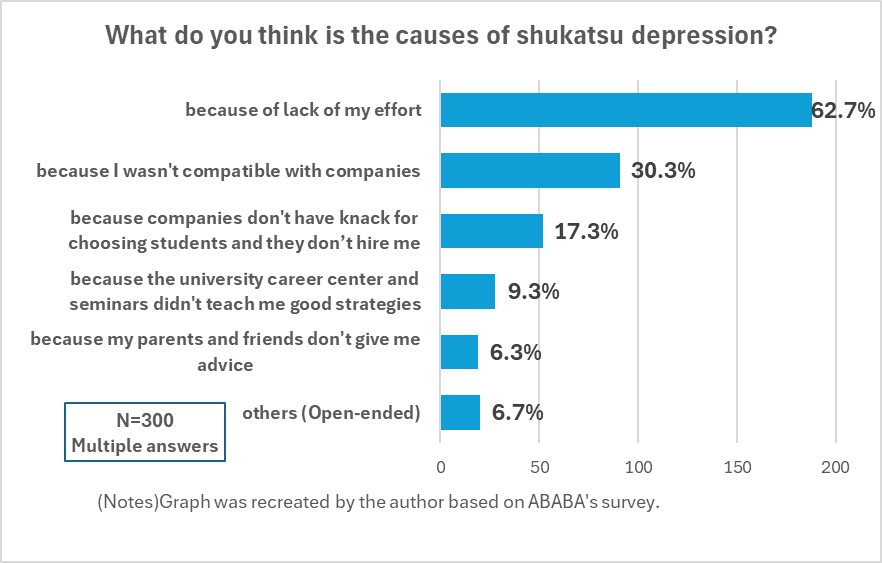
Besides, the Japanese tendency toward excessive self-blame may be one of the factors of shukatsu depression. When asked “What do you think is the causes of shukatsu depression?” in the same survey4, 62.7% answered “Because of lack of my effort.”
Students have got to start shukatsu earlier
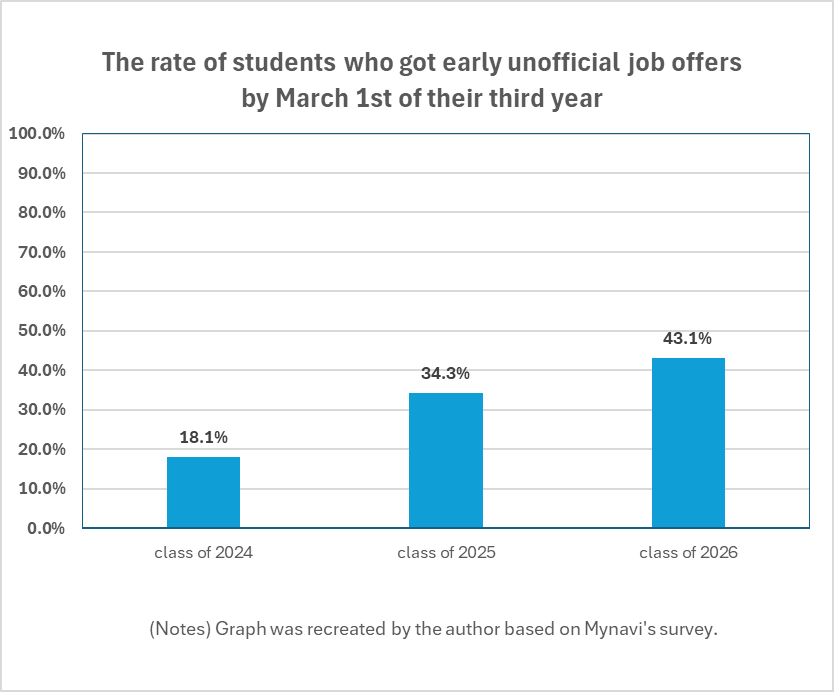
It is also distressing for students that companies start recruitment earlier. Officially, shukatsu publicity and application begin on March 1st for third-year university students. However, this rule (known as the Keidanren rule) has been becoming a formality. According toMynavi, the rate of students who got early unofficial job offers5 by March 1st of their third year is 18.1% for class of 2024, 34.3% for class of 2025, and 43.1% for class of 20266. This indicates that by the time applications open, approximately 40% of students already have early unofficial job offers now.
Companies are now moving up their recruitment timelines to secure outstanding students early. Specifically, they hold internships starting around the summer and offer special recruitment opportunities for participants. So, it has become a strange situation. Even though shukatsu officially begins on March 1st, students have to start shukatsu earlier than the time.
That job-hunting schedule interferes with academic studies. In the fourth year of university, students have mostly finished the credits for graduation, so they can focus on job hunting. However, third-year students still have to attend classes. So, students are pulled by both university and companies. Students have to choose either class attendance or participation in internships.
How is Japan’s student job-hunting process gonna change.
In my prediction, fewer Japanese people will pursue university education going forward. Now, just because we have a college degree, that doesn’t necessarily mean they can enter high income company. The primary reason many Japanese go on to university was that it made it easier to join a better company than if we entered the workforce directly after high school. Besides, we get higher starting salary. That’s why many people chose to go to university even with the high tuition costs.
However, in recent years, Japan’s hiring practices have been changing, and whether students can secure a job offer at a good company increasingly has been becoming depends on how they spent their student life than on their academic background. So, many people find that even if they invest heavily in university education, they can struggle to get a job. A lot of working adults struggle to repay their student loans honestly. Therefore, it is no longer universally true that a university degree is better, and we are at the time we should re-evaluate its advantages and disadvantages. So, more people may choose alternative paths.
I guess the first wave of change will likely occur at high-deviation high schools. I think some of these school students will start choosing paths like starting their own businesses or entering the workforce to get business skills instead of going to university.
Before now, it was common for top high school students to study for high-deviation universities. However, as I mentioned, the advantages of a college degree are diminishing. Consequently, I believe more outstanding students will choose to skip university entrance exams and directly enter business world.
- 厚生労働省「令和7年版 自殺対策白書」 ↩︎
- 株式会社ABABA「就活うつに関するアンケート調査 2024」2024/11/27 https://hr.ababa.co.jp/new-5/SMlN_uZV ↩︎
- same as above ↩︎
- same as above ↩︎
- Companies can’t give a job offer until October 1st of the fourth year due to Keidanren rule, so companies give an early unofficial job offers. That is a virtual job offer. ↩︎
- マイナビキャリアリサーチLab「2026年卒 大学生キャリア意向調査3月<就職活動・進路決定>」2025/4/15 https://career-research.mynavi.jp/reserch/20250415_94762/ ↩︎